
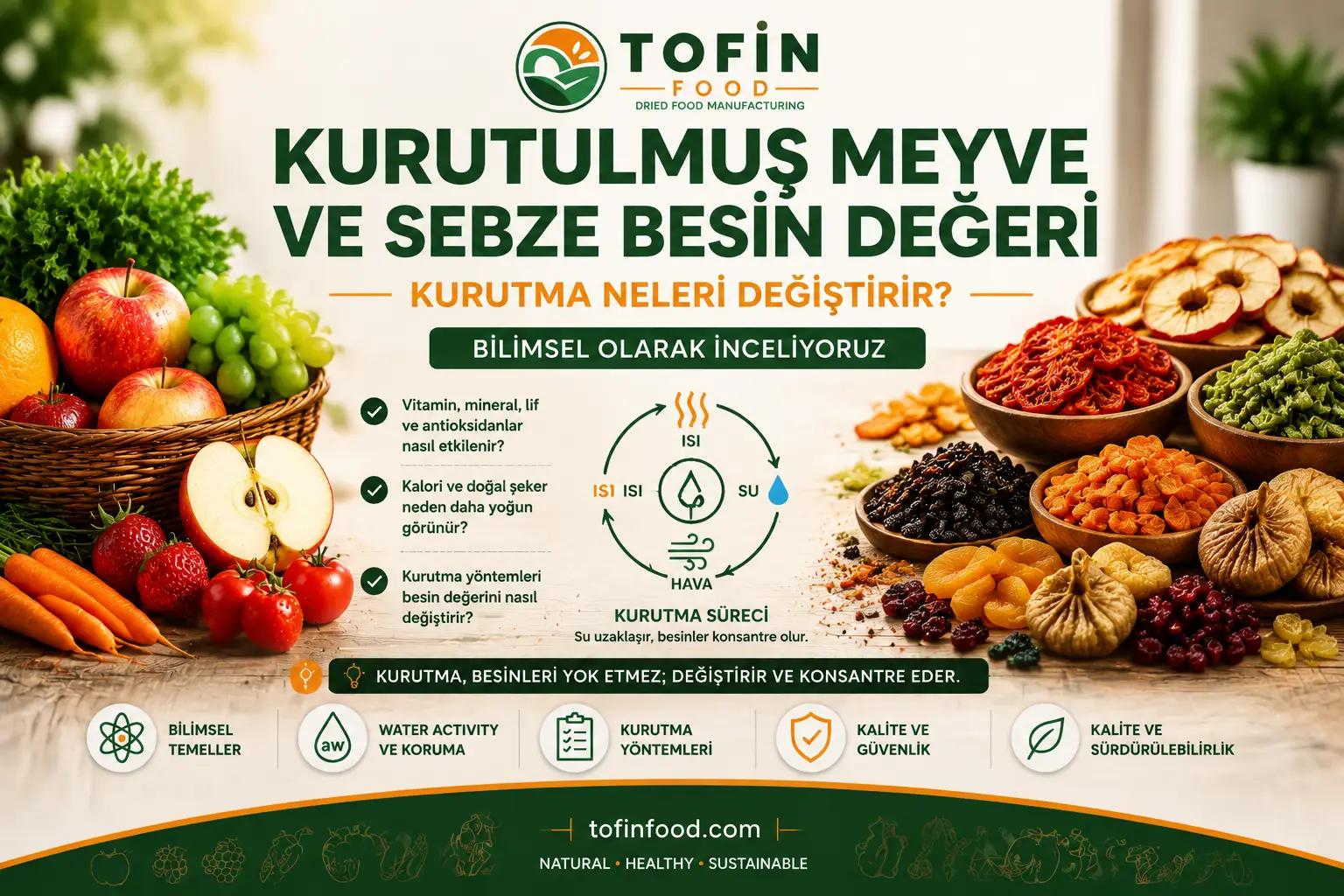
The Nutritional Value of Dried Fruits and Vegetables: How Does Drying Affect Nutrients?
The nutritional value of dried fruits and vegetables changes as water is removed during the drying process.
As the water content decreases, some nutrients may become more concentrated per gram; conversely,
some components, such as vitamin C, which are sensitive to heat and oxidation, may be lost.
For this reason, questions such as “Is dried fruit more nutritious than fresh fruit?”, “Do vitamins disappear when fruit is dried?”,
“Why is dried fruit higher in calories?”, or “Why does dried fruit appear to have a high sugar content?”
do not have a one-word answer.
The effect of drying on nutritional value may vary depending on the type of fruit or vegetable, the characteristics of the raw material,
the pretreatment processes applied, the drying method, temperature, duration, exposure to oxygen, and storage conditions.
Scientific studies also show that different drying techniques can produce varying effects on vitamin C, carotenoids, flavonoids,
phenolic compounds, and antioxidant capacity.
In this article, we will examine how the nutritional value of dried fruits and vegetables changes during the drying process
based on scientific data.
Table of Contents
- What Is the Nutritional Value of Dried Fruits and Vegetables?
- How Does Dehydration Affect Nutritional Value?
- Do Vitamins Disappear When Fruits and Vegetables Are Dried?
- Why Do Dried Fruits Seem to Have More Calories?
- Why Do Dried Fruits Contain More Sugar?
- What Happens to Fiber and Minerals in Dried Fruit?
- How Does Drying Affect Antioxidants and Bioactive Compounds?
- Do Dried Vegetables Retain Their Nutritional Value?
- Does the Drying Method Affect Nutritional Value?
- Is Drying at a Lower Temperature Always Better?
- Does Dried Fruit Help You Lose Weight?
- Which Is More Nutritious: Fresh or Dried?
- What Should You Look for When Choosing Dried Fruits and Vegetables?
- Conclusion
What Is the Nutritional Value of Dried Fruits and Vegetables?
To accurately interpret the nutritional value of dried fruit, one must first understand the
most fundamental change that occurs during the drying process:
A significant portion of the water in the product is removed.
Fresh fruits and vegetables aren’t just made up of vitamins, minerals, carbohydrates, and fiber.
Water makes up a significant portion of their weight.
When a significant portion of this water is removed during drying, the product’s total weight—and often its volume—decreases.
However, not all components in the product’s dry matter are removed in the same proportion as the water.
For this reason, certain nutritional components may appear to be more concentrated in 100 grams of the dried product.
For example, the natural sugars, dietary fiber, and minerals found in fresh fruit,
can be found in a smaller product mass after the water has been removed.
For this reason, when comparing 100 grams of fresh fruit to 100 grams of dried fruit
it can be seen that certain nutritional values are higher in the dried product.
Concentration does not mean the formation of new nutrients.
The drying process does not naturally produce fiber, minerals, energy, or natural sugars in the product.
A decrease in water content may alter the proportion of the remaining components in the product's unit weight.
At the same time, some sensitive food components may degrade during the drying process.
Therefore, when evaluating the nutritional value of dried fruit, two processes must be considered together:
Concentration due to water loss
and
Nutrient losses that may occur during the process.
How Does Dehydration Affect Nutritional Value?
During the drying process, numerous process parameters come into play, such as temperature, air movement, relative humidity, product thickness,
duration, and the technology used.
We have previously covered the basic mechanism of drying, heat and mass transfer, water activity, and the operating principles of various drying technologies
in detail in our guide
What Are Dried Fruits and Vegetables? How Does Drying Work Scientifically?
.
In terms of nutritional value, two key changes are particularly important.
Water Removal and Nutrient Concentration
As the water content of the product decreases during drying, the dry matter content increases.
As a result , the amounts of certain components—such as carbohydrates, natural sugars, fiber, energy, and some minerals —
may appear higher per 100 grams of product.
This is especially important when interpreting the calorie and sugar content of dried fruit.
Nutrient Losses During Drying
During the drying process, the product may be exposed to heat, oxygen, and process conditions for a certain period of time.
This situation may particularly affect sensitive components such as vitamin C, certain carotenoids, and phenolic compounds.
Scientific research on dried fruits and vegetables shows that drying temperature, duration,
airflow rate, and the method used can all play a role in the final nutritional quality.
Concentration and protection are not the same thing.
The fact that a nutrient appears to be present in higher amounts per 100 grams of the dried product does not
mean that there was no loss of that nutrient during the drying process.
Do Vitamins Disappear When Fruits and Vegetables Are Dried?
Some vitamins may be lost during the drying process.
However, it is not accurate to say that all vitamins are completely lost.
Vitamins have different chemical properties.
For this reason, their resistance to heat, oxygen, light, and processing time also varies.
Vitamin C, in particular, is one of the components frequently analyzed
to assess the nutritional quality of dried fruits and vegetables.
Vitamin C, or ascorbic acid, is sensitive to heat and oxidation.
Extended processing times or improper processing conditions can lead to a reduction in the amount of vitamin C in the product.
A scientific review examining the effects of drying on the antioxidant components of fruits and vegetables
,
shows that ascorbic acid, carotenoids, flavonoids, phenolic acids, and antioxidant capacity
can be affected by the drying technique used.
Does a Lower Temperature Always Preserve More Vitamins?
At first glance, one might think that a lower temperature is better.
However, in the drying process, it is not only temperature that matters, but also duration.
While a lower temperature may help protect certain sensitive components, it can also result in a longer drying time.
As a result, the product may be exposed to oxygen and process conditions for a longer period of time.
That's why professional drying isn't just about temperature:
temperature + time + weather conditions + product characteristics
They should be evaluated together.
“There are no vitamins left in dried fruit.”
the phrase,
“Drying preserves all the vitamins.”
That statement is also overly general.
Why Do Dried Fruits Seem to Have More Calories?
One of the most common mistakes regarding the calorie content of dried fruit,
is to directly compare fresh and dried products based on the same weight.
The drying process does not spontaneously add new calories to the fruit.
What really changes is the amount of water.
Fresh fruit
Fruit components + a high amount of water
↓
Drying
A significant portion of the water is removed
↓
Dried fruit
Less water + higher dry matter content
Water does not provide energy. Therefore, as the amount of water decreases,
the energy density of dried fruit per gram may increase.
For this reason, 100 grams of dried fruit may have a higher energy value than 100 grams of fresh fruit.
However, this does not mean that new energy is generated during the drying process.
The same weight of dried produce may represent a greater amount of fruit solids than the same weight of fresh produce.
For this reason, from the consumer’s perspective, rather than simply comparing 100 grams of fresh produce to 100 grams of dried produce
, it makes more sense to also take actual serving sizes into account.
Because the volume of dried fruit decreases, it is possible to consume a significant amount of dry matter in a small portion.
Why Do Dried Fruits Contain More Sugar?
Dried fruit may contain a higher concentration of natural sugar per gram than fresh fruit.
The reason for this is, once again, primarily the removal of water.
Fruits naturally contain sugars such as glucose, fructose, and sucrose.
While a significant portion of the product’s moisture is removed during drying, a significant portion of the natural sugars may remain in the dry matter.
Water ↓
Product weight ↓
Concentration of natural sugar per gram ↑
For this reason, the total sugar content in 100 grams of dried fruit,
may appear higher than that in 100 grams of the same fruit when fresh.
Does Dehydrating Add Sugar to Fruit?
No.
A simple drying process does not, on its own, add new sugar to the fruit.
However, sugar, syrup,
fruit juice concentrate, or similar ingredients may be added to some commercially dried products during production.
For this reason, two different situations must be distinguished from one another:
The fruit's natural sugar becomes concentrated due to water loss
and
the addition of sugar to the product at a later stage.
That is why it is important to check the list of ingredients when buying a dried fruit product.
What Happens to Fiber and Minerals in Dried Fruit?
Dietary fiber and minerals do not behave the same way as sensitive vitamins, such as vitamin C.
Dietary Fiber
Fruits naturally contain dietary fiber.
The drying process does not produce new fiber in the product.
However, because water is removed, dried fruit,
may have a higher fiber density compared to the same weight of fresh fruit.
For this reason, many dried fruits can provide a significant amount of dietary fiber in specific portions.
A higher fiber content does not mean that drying produces fiber.
This situation is largely due to the concentration of dry matter resulting from water loss.
Minerals
Minerals such as potassium, magnesium, calcium, and iron have different chemical properties than vitamins.
However, the final mineral content does not depend solely on the drying temperature.
In addition to the raw material’s natural mineral content, washing, peeling, cutting, and certain pretreatment processes can also affect the final product’s composition.
For this reason, rather than making a definitive statement such as “minerals are not affected in any way by drying,”
it is necessary to evaluate the entire process chain.
How Does Drying Affect Antioxidants and Bioactive Compounds?
The nutritional value of dried fruits and vegetables is not limited to protein,
carbohydrates, vitamins, and minerals.
In plant-based foods:
- carotenoids,
- flavonoids,
- phenolic acids,
- polyphenols
Various bioactive compounds, such as these, may also be present.
The effect of drying on these compounds is not one-sided.
A scientific review examining the effect of drying methods on the antioxidant potential of fruits and vegetables
,
shows that the technology used can produce different results regarding ascorbic acid, carotenoids, flavonoids, phenolic acids,
total phenolic content, and antioxidant activity.
“Drying completely destroys antioxidants.”
or
“Drying fully preserves antioxidants.”
Statements such as these do not constitute a proper scientific approach.
What About Lycopene and Beta-Carotene?
Lycopene in tomatoes and beta-carotene in carrots are among the important carotenoid compounds.
The behavior of these compounds during drying depends on the product's composition and the process conditions used.
For this reason, it would be more appropriate to examine the topics of lycopene in dried tomatoes and
beta-carotene in dried carrots in more detail in separate articles on the TOFiN Food Information Center.
Is It Just the Amount That Matters?
In nutritional science, research focuses not only on the total amount of a compound present in a product, but also on
the extent to which that compound is released from the food matrix during digestion.
This concept is known as bioaccessibility.
A recent scientific review
,
discusses how different drying technologies may also affect the behavior of polyphenols found in fruits and vegetables
during digestion.
For this reason, simply asking, “How many milligrams of polyphenols are left in the product?” may not always paint the full picture.
Do Dried Vegetables Retain Their Nutritional Value?
Yes.
Dried vegetable products may still contain fiber, minerals, and, depending on the product, various
vitamins and bioactive compounds even after drying.
However, the nutritional profiles of fresh and dried vegetables are not exactly the same.
When water is removed, some components may become more concentrated per unit weight.
Conversely, vitamin C in particular, as well as certain carotenoids and phenolic compounds, may be affected by the drying conditions.
“Dried vegetables have no nutritional value.”
in other words,
“Dried vegetables retain all the nutritional value of fresh vegetables.”
It is not correct to say that either.
The nutritional value of the final dried food product should be evaluated by taking into account the product itself and the processing conditions used.
Does the Drying Method Affect Nutritional Value?
Yes.
Different drying technologies do not subject the product to the same temperature, duration, and oxygen conditions.
You can explore the basic operating principles of technologies such as hot air, heat pumps, vacuum drying, and freeze-drying in detail at
in our fruit and vegetable drying guide at
.
The important point regarding nutritional value is that different methods result in different:
temperature + time + oxygen exposure + moisture removal rate
is to generate combinations.
Some scientific studies have shown that freeze-drying can offer advantages in preserving certain sensitive components.
However, it is not appropriate to evaluate a drying method solely based on vitamin retention.
When selecting an industrial process, one must also:
- final product quality,
- texture,
- color,
- rehydration,
- processing time,
- capacity,
- energy consumption,
- production cost
Factors such as these are also taken into account.
Therefore, there is no single “best drying method” for all products.
Is Drying at a Lower Temperature Always Better?
Low temperatures can help preserve certain heat-sensitive food components.
However, low temperatures can also cause the drying time to increase.
This allows the product to be exposed to oxygen, air, and process conditions for a longer period of time.
For this reason, it is not enough to assess the effect of drying on nutritional value solely by asking, “
”
“At what temperature was it dried?”
A more accurate approach:
Temperature + time + weather conditions + product characteristics + desired end product
to evaluate these parameters together.
Therefore, the answer to the question “Does drying affect nutritional value?” is yes;
however, the direction and magnitude of the effect cannot be explained by temperature alone.
Does Dried Fruit Help You Lose Weight?
Dried fruit is not a food that causes weight loss or “helps you lose weight” on its own.
Changes in body weight are related to a person’s total energy intake, energy expenditure,
overall dietary patterns, and individual characteristics.
Dried fruits can provide dietary fiber and various nutrients.
However, because it has a low water content, its energy density per gram may be higher than that of fresh fruit.
For this reason, it is possible to consume a relatively large amount of energy in a small volume.
In some observational studies, dried fruit consumption has been associated with higher dietary quality or lower body weight measurements
. However, an observational association does not prove that dried fruit causes weight loss .
“You’ll lose weight by eating dried fruit.”
Making a health claim of this nature is not scientifically accurate.
Dried fruit can be part of a general diet;
however, portion size and total energy intake should be taken into account.
Which Is More Nutritious: Fresh or Dried?
There is no single winner in this issue.
Even if fresh and dried fruit are made from the same raw material, their nutritional profiles may differ.
Fresh Fruits and Vegetables
It contains a higher water content. In particular, certain components that are sensitive to heat and oxidation have not been subjected to the drying process.
Dried Fruits and Vegetables
Because a significant portion of the water has been removed, it has a more concentrated dry matter composition.
Therefore, per unit weight:
- energy,
- natural sugar,
- fiber,
- certain minerals
may be more concentrated.
Conversely, losses of vitamin C and certain bioactive compounds may occur depending on processing conditions.
Fresh and dried products are not exact nutritional equivalents.
Instead of automatically declaring a product healthier simply because it is “fresh” or “dry,”
the product’s ingredients, serving size, and production method should all be considered together.
What Should You Look for When Choosing Dried Fruits and Vegetables?
When evaluating a dried fruit or vegetable product
it is not enough to simply look at the product name on the front of the package.
Table of Contents
Is the product made only from fruits or vegetables? Does it contain any additional ingredients?
Added Sugar
A distinction must be made between the fruit’s natural sugar and added sugar.
Serving Size
Because dry products are more concentrated, even small portions can contain significant amounts of dry matter and energy.
Production Method
The raw materials used, pretreatment processes, and drying technology can affect the final product's properties.
Packaging and Storage
Protecting dried products from moisture and storing them under the conditions specified by the manufacturer is important for quality.
For this reason, a high-quality dried product should not be evaluated solely based on “how dry it is.”
Raw materials + process + formulation + packaging + storage must be evaluated as a whole.
Conclusion: Dehydration Does Not Destroy Nutrients, But It Does Alter Them
The most common mistake regarding the nutritional value of dried fruits and vegetables is
to explain the topic from one of two extremes:
“Drying destroys all nutrients.”
or
“Drying preserves and enhances all nutrients.”
Both statements are too general from a scientific standpoint.
During the drying process, a significant portion of the water in the product is removed.
As a result, components such as natural sugars, fiber, energy, and certain minerals
may become more concentrated per unit weight of the dried product.
At the same time, changes or losses in vitamin C, certain carotenoids, phenolic compounds, and other sensitive components
may occur depending on the drying conditions.
For this reason, there is no single factor that determines the final nutritional profile:
Raw material + pretreatment + drying method + temperature + duration + process conditions + packaging + storage
They should be evaluated together.
Therefore, the right question is not simply, “Does drying preserve nutritional value?”
A better question:
Which product, which nutrient, which drying method, and under which process conditions does it change, and how?
This is the most accurate approach to scientifically evaluating the nutritional value of dried fruits and vegetables.
Scientific Sources and Further Reading
Kamiloglu et al. — Effect of Drying on the Antioxidant Potential of Fruits and Vegetables
A scientific review examining how vitamin C, carotenoids, flavonoids, phenolic acids, and antioxidant capacity are affected by different drying methods
View on PubMed
Redha et al. — Drying Technologies and Polyphenol Bioaccessibility
A recent scientific review examining the effect of drying technologies on the behavior of polyphenols found in fruits and vegetables during digestion
View on PubMed
TOFiN Food — What Are Dried Fruits and Vegetables? How Does Drying Work Scientifically?
A guide to the basic principles of drying, water activity, heat and mass transfer, and fundamental drying technologies.
Read the TOFiN Food guide