
What Are Dried Fruits and Vegetables? How Does the Drying Process Work Scientifically?
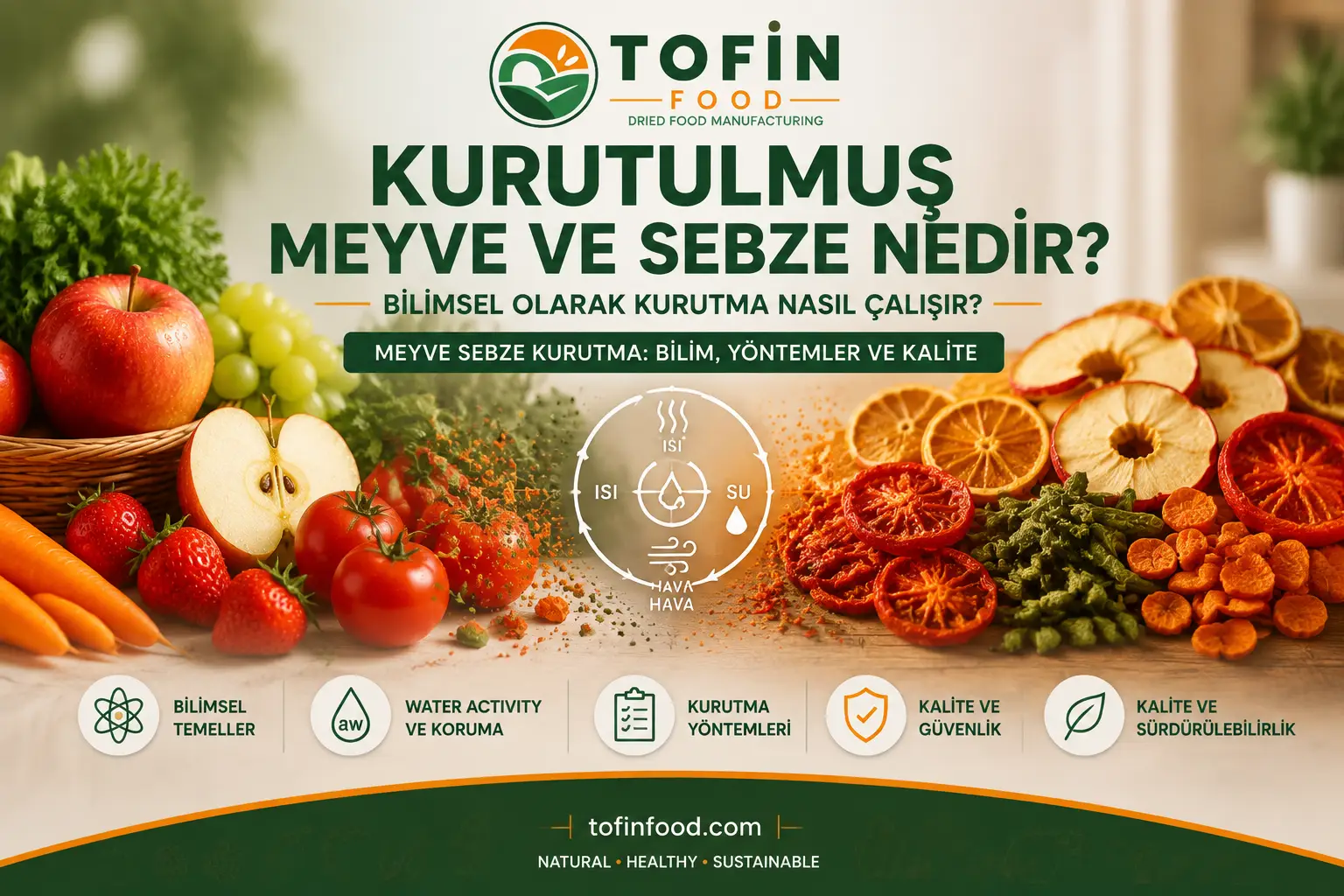
What Are Dried Fruits and Vegetables? How Does the Drying Process Work Scientifically?
Drying fruits and vegetables is one of the oldest methods used for food preservation. However, in modern food technology, drying does not simply mean reducing the water content of a fruit or vegetable by leaving it in a warm environment. A controlled drying process is a technical procedure in which numerous parameters—such as temperature, relative humidity, air movement, the physical properties of the product, and time—are managed in conjunction.
From a scientific perspective, food drying is fundamentally based on the principle of removing a certain portion of the water from the product. For this to occur, energy must be transferred to the product, the moisture within the product must be transported to the surface, and the water that reaches the surface must be removed from the system.
In the technical notes on food dehydration published by the Food and Agriculture Organization of the United Nations (FAO), drying is described as a process involving simultaneous heat and mass transfer.
So what actually happens when a slice of apple, a tomato, a carrot, or another vegetable goes into a dehydrator? How is the water removed from the food? Why are temperature, air, and humidity important? What is the science behind the fact that dehydrated foods can be stored for longer periods of time?
In this article, we will examine the basic scientific principles of the fruit and vegetable drying process step by step.
Table of Contents
- What Is Fruit and Vegetable Dehydration?
- Why Is Water Important in Fruits and Vegetables?
- What Is Moisture Content?
- What Is Water Activity?
- How Does the Fruit and Vegetable Drying Process Work Scientifically?
- Heat Transfer and Mass Transfer
- What Factors Affect the Drying Process?
- How Does Dehydration Change the Structure of Fruits and Vegetables?
- How Does Dehydration Help Preserve Food?
- What Are the Methods for Drying Fruits and Vegetables?
- What Determines the Quality of Dried Fruits and Vegetables?
- Conclusion
What Is Fruit and Vegetable Dehydration?
Fruit and vegetable drying, or dehydration, is a food processing and preservation method in which the water content of the product is reduced in a controlled manner.
The FAO’s technical resource on drying and dehydration defines drying as one of the oldest food preservation methods used by humankind. The removal of moisture through drying helps limit the growth and multiplication of microorganisms that can cause spoilage and reduces many moisture-related spoilage reactions.
The purpose of drying a fruit or vegetable is not merely to reduce its weight. One of the primary objectives is to make the product more stable by reducing the amount of water it contains—specifically, the water that is available for various reactions involving microorganisms.
As water is removed, the product’s weight—and often its volume—decreases. For this reason, a dried apple slice may be lighter and smaller than a fresh apple.
However, to obtain a high-quality dried product, it is not enough to remove as much water as possible as quickly as possible.
The drying process can also affect the product’s color, aroma, texture, and physical structure. Therefore, the goal of industrial drying is to achieve the target moisture and water activity levels while maintaining control over the desired product characteristics.
As part of TOFiN Food’s fruit and vegetable drying solutions, various fruits and vegetables can be processed according to industrial needs.
Why Is Water Important in Fruits and Vegetables?
A significant portion of fresh fruits and vegetables is made up of water.
However, water is not merely a component that makes up the product’s weight. The physical structure of fruits and vegetables, their freshness, and many of the biological or chemical processes that occur in food are closely related to water.
Therefore, to understand food preservation, we must first distinguish between two different concepts:
Moisture content and water activity (aw).
Although these two concepts are related, they do not mean the same thing.
What Is Moisture Content?
Moisture content, simply put, refers to the total amount of water present in a food product.
For example, let’s consider that a significant portion of a fresh fruit’s weight consists of water. When a significant portion of this water is removed during the drying process, a product with a lower weight remains.
However, knowing the total moisture content of a product is not sufficient on its own to explain its microbiological and physicochemical stability.
Because not all of the water in food behaves the same way.
What Is Water Activity?
Water activity (aw) is an important food science parameter that provides information about the availability of water in food.
Technically, water activity is the ratio of the vapor pressure of a food under specific conditions to the vapor pressure of pure water under the same conditions.
According to the U.S. Food and Drug Administration’s (FDA) explanation of water activity, the water activity of most foods is above 0.95, and these levels can provide sufficient moisture for the growth of many bacteria, yeasts, and molds.
The key point here is this:
Moisture content and water activity are not the same thing.
The FAO also notes that two foods with the same water content can have very different aw values depending on the extent to which the water is bound to the food’s components.
For this reason, in professional food production, only:
“What is the moisture content of the product?”
Not a question, but when necessary:
“What is the product’s water activity value?”
That question is also important.
Since the topic of water activity is quite comprehensive in terms of understanding the shelf life and microbiological stability of dry foods, it is a subject that should be addressed separately.
How Does the Fruit and Vegetable Drying Process Work Scientifically?
The basic physics behind drying is based on two phenomena occurring simultaneously:
Heat transfer and mass transfer.
According to the FAO’s technical document on the dehydration of fruits and vegetables, energy must be supplied to evaporate the water in the product, and the resulting water vapor must be removed from the product.
We can think of the process in simplified terms as follows:
Energy → Product
Moisture → Out of the product
Heat Transfer
When the drying air comes into contact with the product's surface, energy is transferred from the air to the product.
This energy is necessary to remove the water from the product.
In air-based drying systems, convection is an important heat transfer mechanism. As hot air flows around the product, it transfers energy to it.
However, a higher temperature does not always mean a better end product.
While increasing the temperature can speed up the drying process under the right conditions, it can also affect the product’s color, aroma, texture, and other quality characteristics.
For this reason, in industrial drying, it is not just speed that matters, but the balance between drying performance and the quality of the final product.
Mass Transfer
The second issue is the leakage of water from inside the product.
The FAO explains this process in two main stages:
- The movement of water from inside the product to the surface.
- The removal of surface water from the environment in the form of water vapor.
Let’s consider the moisture at the center of a slice of apple. This moisture must first move from the interior of the product toward the surface. Once it reaches the surface, it can be removed as water vapor and carried away from the environment by the drying air.
As the drying process progresses, the amount of moisture on the surface that can be easily removed decreases. The transport of moisture from the interior of the product to the surface becomes increasingly important.
For this reason, the drying rate for many products is not constant throughout the process.
What Factors Affect the Drying Process?
The process of drying fruit or vegetables is not simply a process controlled by adjusting the temperature.
There are numerous variables that affect the drying rate and the final product characteristics.
Temperature
The temperature difference between the drying air and the product affects the heat transfer to the product.
In general, increasing the temperature under appropriate conditions can increase the rate of moisture removal. However, inappropriate process temperatures can cause undesirable changes in the product’s quality characteristics.
For this reason, the FAO states that a time-temperature balance must be established between achieving the maximum drying rate and preserving food quality.
Relative Humidity
It is not only the temperature of the drying air that matters, but also the moisture it contains.
Drier air has a greater capacity to absorb water vapor removed from the product. As the air approaches saturation, its capacity to carry additional moisture decreases.
Therefore, when evaluating the drying process, only:
“At what temperature was it dried?”
It is not enough to simply ask the question.
Humidity conditions are also an important part of the process.
Air Speed
Water that evaporates from the product's surface humidifies the air around it.
Air movement helps remove this moist air and allows fresh, dry air to reach the surface.
According to the FAO, moving air can help disperse the moist atmosphere at the surface, thereby facilitating continued moisture transfer.
Product Thickness and Size
The way a product is cut does not only determine its appearance; it also affects its drying behavior.
The FAO explains two important effects of preparing fruits and vegetables in small pieces or thin slices:
- An increase in the surface area exposed to air.
- A reduction in the distance that heat and moisture must travel within the product.
For this reason, slice thickness is an important process parameter in industrial production.
Drying pieces of different thicknesses from the same product together can cause the pieces to dry at different rates and compromise the uniformity of the final product.
Drying Time
The drying time is entirely dependent on the parameters listed above.
In a professional process, the goal is not merely to dry the product for a certain number of hours, but to achieve the desired final product characteristics.
For this reason, it is important to evaluate the final product in terms of moisture content, water activity, and other product-specific quality criteria.
How Does Dehydration Change the Structure of Fruits and Vegetables?
Drying does more than just remove water from the product.
Water loss can also cause changes in the physical structure of fruits and vegetables.
One of these is shrinkage, that is, contraction or a reduction in volume.
In the scientific literature, shrinkage during food drying is considered one of the significant physical changes related to the product’s structure and final quality characteristics.
As water is removed, the cellular structure may change, the product may shrink, and its porosity may vary.
As a result, the product:
- texture,
- color,
- volume,
- density,
- crispness or chewiness,
- water intake, or rehydration behavior
may vary.
For this reason, the same fruit or vegetable can result in products with different physical properties when different food-drying methods and different processing conditions are used.
The quality of the dried product depends solely on:
“How dry is it?”
It cannot be evaluated based on that question.
How Does Dehydration Help Preserve Food?
One of the most important purposes of drying is to extend the shelf life of food.
One of the key mechanisms involved is the reduction of water activity.
In simple terms:
Water is removed → Water activity decreases → The amount of water available to microorganisms decreases → Microbial growth is progressively limited.
According to the FAO’s technical note, moisture removal helps prevent the growth and multiplication of microorganisms that cause spoilage and reduces many moisture-mediated spoilage reactions.
However, a very important scientific distinction must be made here:
Drying Is Not Sterilization
Reducing water activity can inhibit the growth of many microorganisms.
However:
“Can’t reproduce” = “Dead”
does not mean that.
Scientific research on the survival of pathogens in foods with low water activity indicates that some foodborne pathogens can remain viable for long periods under dry conditions.
In addition, the relationship between low water activity and the heat resistance of microorganisms is also examined in the food safety literature.
Therefore, food safety in dried foods should not be attributed solely to the drying process.
Raw material inspection, hygiene, process control, proper packaging, storage, and the necessary microbiological tests are key components of the production system.
What Are the Methods for Drying Fruits and Vegetables?
Today, various methods are used to dry fruits and vegetables.
Although all food drying methods are fundamentally aimed at reducing the moisture content of the product, the transfer of energy to the product and the removal of moisture vary depending on the technology used.
Sun-Drying
Sun-drying is one of the oldest drying methods.
The product is dried using direct sunlight and the surrounding air.
Although it is simple and requires minimal equipment, control over temperature, air movement, relative humidity, and environmental conditions is limited.
An open environment can also expose the product to dust, insects, and other environmental factors.
Solar Drying
Solar drying is different from drying directly in the open air under the sun.
Solar energy is utilized, but the air and the product can be controlled within a specially designed drying system.
For this reason, it may be possible to create more controlled process conditions compared to drying in direct sunlight.
Drying with Hot Air
In hot-air drying, heated air is passed over or through the product.
As air transfers energy to the product, it also carries away water vapor that is escaping from the surface.
Various equipment designs—such as tray dryers, cabinet-type dryers, tunnel dryers, fluidized-bed dryers, or belt dryers—can take advantage of this basic principle.
Heat Pump Drying
In heat pump drying systems, controlling not only the temperature but also the humidity of the drying air, as well as conditioning the air within the system, plays an important role.
By removing moisture from the air and restoring the air to conditions suitable for drying, a controlled drying environment can be created.
The operating principle of heat pump drying, its energy consumption, and how it differs from other drying technologies constitute a comprehensive topic in and of itself.
Vacuum Drying
In vacuum drying, the process is carried out at a pressure lower than atmospheric pressure.
Reducing the pressure may make it possible to remove the water at lower temperatures.
This feature can offer advantages in the processing of certain heat-sensitive products.
Freeze-Drying
Freeze-drying, or lyophilization, works on a different principle than many other drying methods.
The product is first frozen. Then, under low-pressure conditions, the ice is allowed to turn directly into water vapor without first becoming a liquid— a process known as sublimation.
This method can be used to produce products with different porosity and texture properties. However, the equipment, process time, energy consumption, and economic conditions differ from those of other technologies.
For this reason, it is not accurate to identify a single technology as the “best drying method” for all fruits and vegetables.
The FAO also notes that factors such as the characteristics of the raw material, the target end product, the required operating conditions, and operating costs must be taken into account when selecting drying technology.
What Determines the Quality of Dried Fruits and Vegetables?
Producing high-quality dried fruits and vegetables is not just a matter of choosing the right drying technology.
The final product is influenced by the entire production chain:
Raw material quality → variety and ripeness → washing and preparation → cut size → necessary pretreatments → drying temperature → relative humidity → air velocity → duration → final moisture content → water activity → cooling → packaging → storage
Changes in this chain may affect the product's color, aroma, texture, stability, and usage characteristics.
Packaging is especially important.
If a dried product is stored under unsuitable conditions, it may reabsorb moisture from the environment. The FAO’s explanations regarding water activity and moisture balance indicate that dried food can gain or lose moisture depending on the relative humidity of its surroundings.
For this reason, professional food drying is not a process that ends the moment the product leaves the dryer.
The selection of raw materials, controlled processes, measurement, cooling, packaging, and storage must be evaluated as a whole.
Conclusion: Drying Is Not Just About Removing Water
At first glance, drying fruits and vegetables may seem like a simple process: the water is removed from the produce, resulting in a drier product.
From a scientific perspective, however, the process is much more comprehensive.
During drying, heat and mass transfer occur simultaneously. As energy is transferred to the product, the moisture inside the product moves to the surface, evaporates, and is removed from the environment.
Temperature, relative humidity, air velocity, product thickness, and drying time all affect how this process unfolds.
Reducing the water content—and particularly water activity—can help preserve the product by limiting the growth of many microorganisms. However, drying is not sterilization, and proper raw material selection, hygiene, process control, packaging, and storage practices remain critical for food safety.
At the same time, drying can alter the product’s cellular structure, volume, color, texture, and rehydration behavior.
For this reason, a successful drying process should be evaluated not only by “how much water is removed from the product,” but also by whether the final product meets the targeted specifications.
At TOFiN Food, we view the drying of fruits and vegetables not merely as a process of removing water, but as a controlled food processing procedure in which the characteristics of the raw materials, process parameters, and the desired final product quality are all taken into account.
Scientific Sources and Further Reading
FAO — Fruit and Vegetable Processing: Preservation by Drying and Dehydration
A technical resource on drying, water activity, heat and mass transfer, drying parameters, and drying methods.
https://www.fao.org/4/V5030E/V5030E0b.htm
U.S. Food & Drug Administration (FDA) — Water Activity (aw) in Foods
The definition, measurement, and importance of water activity in food stability.
PubMed — Shrinkage of Food Materials During Drying
Scientific literature on volume and structural changes that occur during drying.
https://pubmed.ncbi.nlm.nih.gov/33350150/
PubMed — Survival of Foodborne Pathogens in Low-Water-Activity Foods
A scientific study on the survival of microorganisms under low-water-activity conditions.
https://pubmed.ncbi.nlm.nih.gov/23317872/
PubMed — Water Activity and Thermal Resistance of Microorganisms
A scientific source on the relationship between water activity and the thermal resistance of microorganisms.
for Dried Fruits and Vegetables
Your Trusted Production Partner
For wholesale dried fruits and vegetables, as well as custom production and private-label solutions, contact TOFiN Food. Let’s work together to plan the product, cut, packaging, and production options that best suit your needs.